





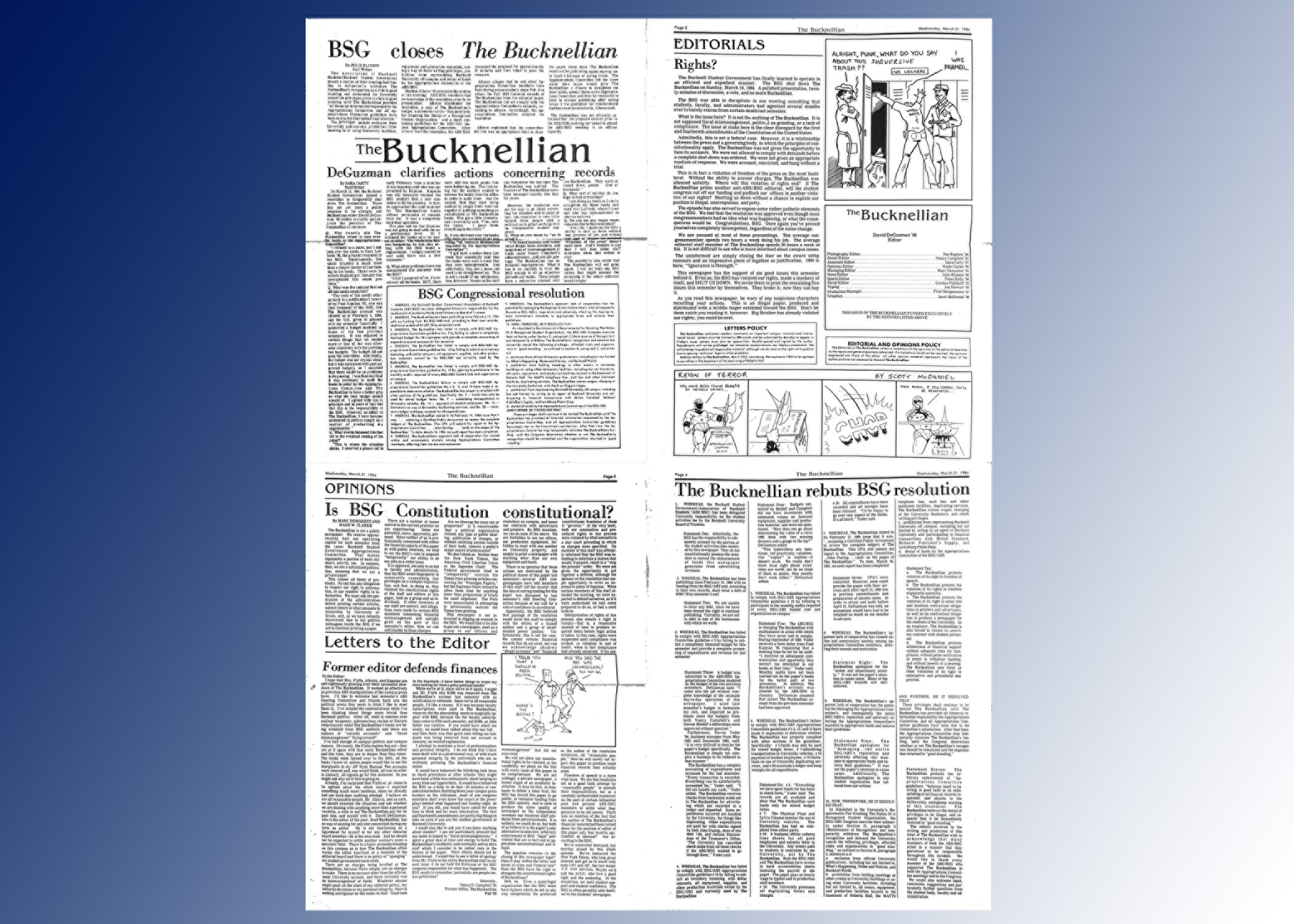








In the 10th grade, I read George Orwell’s widely banned novel, “1984.” Published in 1949, the novel takes place in a totalitarian society that uses mass surveillance, propaganda and censorship to manipulate and control citizens. The general population is heavily surveilled through all cracks, corners and crevices throughout the nation by the Party, whose leader is known as Big Brother. Big Brother, the mystical entity who sees all, is constantly watching, ready to report and correct any ill-willed citizens who dare to defy society’s constructs. In my opinion, the novel was often used as a euphemism to scare the young American thinkers away from ideas of communism heavily present in the East. However, I do also think it has a lot of relevance to today and the uprise in social anxiety, specifically within Gen Z.
To preface, I will acknowledge right here and now that social anxiety disorder, or SAD, is indeed a recognized anxiety disorder where one feels symptoms of anxiety or fear in situations where they may be scrutinized, evaluated or judged by others. According to the National Institute of Mental Health website, individuals with SAD may also have struggles completing everyday tasks such as eating in front of others or even using a public restroom, due to concerns about being humiliated, judged or rejected. As my final disclaimer, I will also add that I am no doctor, I am simply an English major with a few things to say. Anyways, onwards with my point.
In the digital age where our every movement is tracked by the black beady eyes of our cell phones, it’s hard not to feel constantly surveilled. You tripped over your croc? Best believe someone saw that. You waved to someone and they didn’t wave back? Everyone’s laughing at you. You had one too many drinks and danced like no one was watching? Don’t even bother showing your face in public ever again. It’s no wonder so many people suffer from social anxiety.
To some degree, phones, but specifically social media, have ruined our ability to have healthy relationships with ourselves. We as a society have an irrational fear of being embarrassed for being seen. Being seen trying. Being seen in the midst of our emotions. Being seen at our most vulnerable and, quite frankly, our most lovable. Social media allows us to step through a portal to a distant reality where we can curate the most picture-perfect version of ourselves. Everything we interact with and post on social media is intentional; we are choosing the most palatable parts of ourselves and creating a highlight reel of seconds or minutes that we’ve experienced. So, in the real world, when we aren’t constantly our best selves, or stuck in a freeze-frame of picturesque seconds or minutes, we’re bound to feel exposed.
We live in an era where everything we do, known to us or not, is constantly being recorded. Think about the many times you’ve seen videos of people, recorded unbeknownst to them, dancing at concerts, only to be laughed at in comments. Or even the times you’ve been caught in the background of someone else’s photo and to your surprise, are featured in their Instagram photo dump. To this, we also live in a culture where individuality seems to be on the decline. Anything that defies the norms of minimalism, bareness or whiteness is automatically “othered” and subjected to scrutiny. This scrutiny can happen verbally, or with judging stares, whispers and even public shaming. However, I will say that a lot of this judgment tends to come from ourselves first.
More often than some of us would like to admit, we are first to shame ourselves before anyone else is, if they even do. Think about it, how many times have you been concerned about a wrinkle in your shirt, an uncooperative strand of hair or a pimple on your face that absolutely no one, besides yourself, has noticed. Similarly, in this rising battle of “nonchalance,” to me, the real losers are the ones who close themselves off to sharing the joy that is being a human in touch with their emotions. As a society, we seem to care so much about the opinions of people whom we don’t even know. Why are we so afraid to feel embarrassed, specifically for things that are naturally awkward?
Famously said by Austin Butler, “embarrassment is an underexplored emotion.” By embarrassing ourselves, we enter a deeper level of consciousness within ourselves and stability. Living your life to the fullest isn’t exclusive to perfect photos and just the “good times,” but the times in between where you do mess up, you fall down and most importantly, you get back up and try again. Even if people are watching.
I’ll leave you with one final quote by Mr. Perlman, Elio’s father in Luca Guadagnino’s award- winning film, “Call Me By Your Name.” “We rip out so much of ourselves to be cured of things faster than we should that we go bankrupt by the age of thirty and have less to offer each time we start with someone new. But to feel nothing so as not to feel anything— what a waste!”
What a waste indeed.