








This weekend, Bucknell University Choir and Bucknell Voice Lab (BVL) will bring to life “Considering Matthew Shepard,” a poignant choral work by Craig Hella Johnson that commemorates the life of Matthew Shepard and the enduring impact of his tragic murder. The performances, scheduled for Friday, Nov. 7 at 7:30 p.m. and Saturday, Nov. 8 at 2:30 p.m. at the Weis Center, promise an immersive experience that blends music, storytelling and community engagement.
Liz Dondlinger ’26, a senior music education major and production assistant for the performance, is deeply involved both on and off stage. “I’m in both BVL and University Choir for this production,” she said. “I’m also the production assistant, so I’ve worked on promotional materials and poster designing as well.” Fellow performers Brynn Withey ’26, a biochemistry major, and Macey Webber ’27, a junior markets, innovation & design major, emphasized the collaborative nature of the production. “I am in both BVL and University Choir,” Webber explained. “I’m also dancing in a small portion in the performance, and I’m assistant to the director, so I handle the social media posting for this production.”
“Considering Matthew Shepard” is structured like a modern oratorio, a semi-staged musical form that blends choral performance with narrative storytelling. Dondlinger explained, “It used to mean specifically religious songs, but a modern oratorio is basically more staged and more narratively based than a concert, but less staged with less sung and danced than a musical. It is a semi-staged ensemble plus solo production.” The performance weaves together choral pieces, solo performances, recitations and movement to tell Shepard’s story while exploring themes of compassion, acceptance and human dignity.
The narrative unfolds like a “passion story,” Dondlinger said. “First we meet Matthew, we meet his family and you get that very human narrative. We learn about him. Then we get checkpoints of how the night that he died occurred. We hear about his murder in a hate crime and reflect through songs tied to the narrative. Then there’s information about the court proceedings, how his family felt and reflections on community and his legacy. We end by essentially asking, where do we go from here?”
Webber highlighted the multiple perspectives embedded in the performance. “There’s a few pieces concerning Matthew and his family,” she said, “and there’s even a song that Semi Chorus does called “I Am Like You”, humanizing and discussing the two men, Aaron and Russell, who killed him. There are many perspectives throughout the piece, which helps the audience grasp all angles of the story.” Withey added, “There are quite a few points where either the choir or a soloist speaks from the point of view of the fence that he was tied to, and it leads to really emotional moments. It’s very powerful.”
Beyond the stage, the production team has worked to bring the story and its message into the broader Lewisburg community. Dondlinger described the process of balancing performance and production responsibilities: “I’ve been really lucky with all the production tasks I’ve gotten to do. I’ve gotten to email back and forth with workshop leaders, get to know them and also do some graphic design work. It’s been really special to work with the producers and music director Dr. Caleb Hopkins and stage director Dr. Emily Martin to bring this vision to life.”
Webber echoed this sentiment, describing the efforts to connect with the community: “I communicated with someone who works at the campus Barnes & Noble to set up a display of queer authors, and we added our promotional materials there. Also, posting these graphics on the Bucknell Voice Instagram has brought life to the account in a way that it didn’t have before.” Dondlinger emphasized, “Because this project is so community-oriented, all the soloists come out of the choir, representing both the people in the story and the larger community. It’s special to take that out into the Lewisburg community, even just talking with shop owners and putting up materials.”
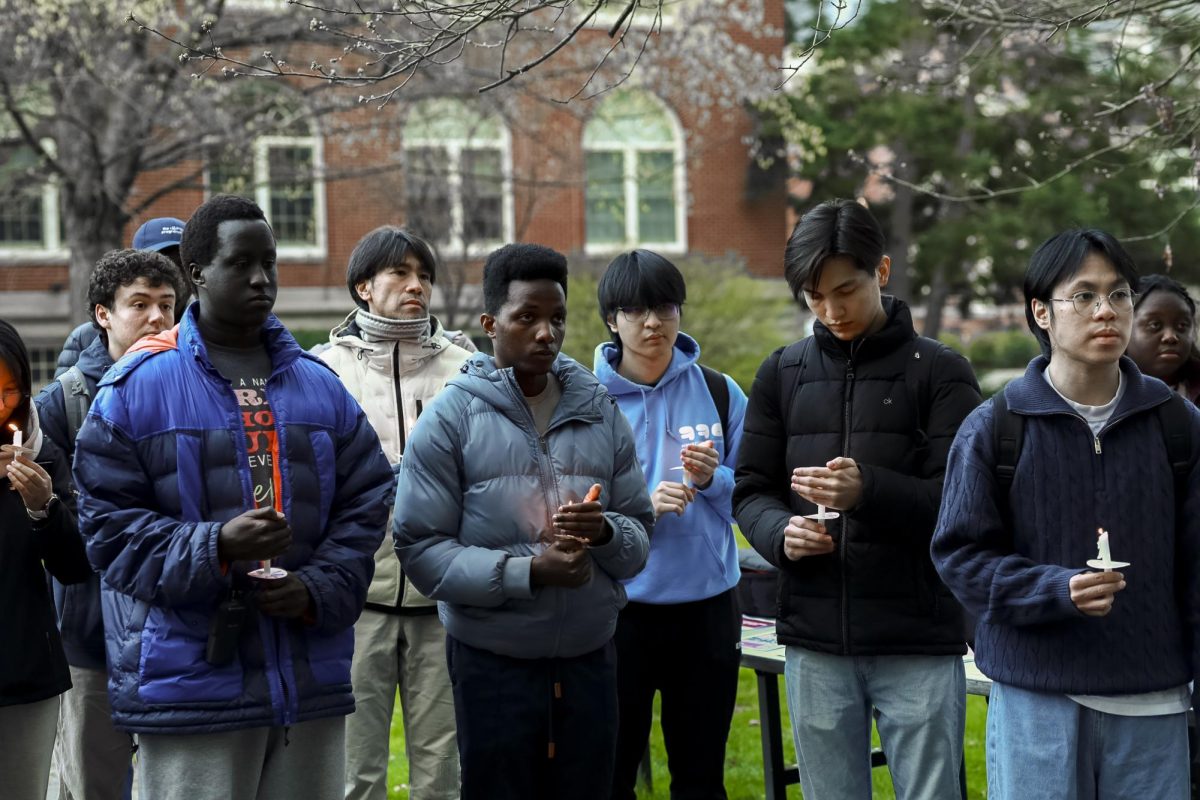
Leading up to the performances, Bucknell has hosted and will continue to host a series of events celebrating LGBTQ+ voices and fostering dialogue. These events include a Service of Remembrance at Rook Chapel, a queer poetics workshop in the Vaughn Literature Library, a talk on queer culture in the 1990s by Associate Professor of Theatre & Dance Bryan Vandevender, a student and faculty recital of works by queer composers and a visibility workshop with Carly Thomsen from Rice University focused on activist strategies. Dondlinger noted, “These events help contextualize the performances and allow the audience to engage with Matthew’s story in multiple ways, not just through music.”
The performances themselves are accompanied by unique educational experiences. On Friday, Nov. 7, Dennis and Judy Shepard, Matthew’s parents, will join a pre-performance Zoom at 6 p.m. “It’s a chance to hear directly from Matthew’s family,” Withey said. Then, on Saturday after the second performance, there will be a talkback with Joanne Carroll, executive director of Trans Advocacy Pennsylvania; Barry Loveland, co-founder and director of the History Project at the Central PA LGBTQ+ Center; and Mary Nancarrow, founder of the Pennsylvania Rural Gay Caucus, moderated by Kurt Nelson, Bucknell’s director of Religious and Spiritual Life.
Both Dondlinger and Webber highlighted the unique power of music and the arts to foster empathy. Withey explained, “The arts are inherently emotional and feeling-based, which leads people to be more receptive to empathy. Hearing queer music and experiencing queer art can influence people in ways that factual discussions sometimes cannot.” Dondlinger added, “Within the oratorio itself, there’s a collage of media types: news articles, poetry and texts from Matthew’s journals. There are also musical styles ranging from classical to country, pop and blues. All these different formats allow audience members to find a personal entry point and have a meaningful experience.”
When asked what she hopes the audience will take away, Dondlinger emphasized the call to action: “This performance acknowledges that this is a hard topic and that these things still happen today. Thoughts and prayers aren’t enough. What can you actually do with these feelings, with this knowledge, with this education, both from the performance and from this week of events? How can you make the world a more accepting, more welcoming place?”
Webber echoed this, highlighting the deeply personal connection to Matthew’s story. “Seeing the production places Matthew as someone’s son, someone’s family member. It encourages the audience to reflect on their own emotions and consider the impact of such violence on a real human being.”
Dondlinger concluded by reflecting on the collaborative nature of the project: “This has been one of the most cooperative and collaborative performances we’ve done. Each person has a stake in this project. In many ways, we each get to be part of the story and part of the legacy of Matthew Shepard, representing a supportive community for queer people.”
Through these performances and the week of accompanying events, Bucknell students and faculty hope to honor Matthew Shepard’s legacy, foster meaningful dialogue and inspire action toward a more compassionate and inclusive world.