












Last week, Bucknell’s Perricelli-Gegnas Center for Entrepreneurship & Innovation hosted alumnus Steve Bass ’79 as a keynote speaker for their Feb. 3 Workshop on Entrepreneurial & Innovative Mindsets in Nonprofits and the Arts. Bass arrived back in Lewisburg on Feb. 1, and during his time on campus, engaged with dozens of students, delivering talks to four classes and spending time in extensive direct conversation at lunch and dinner events. The Bucknellian was lucky enough to speak with Bass about his previous time at Bucknell, as well as what he was up to as part of his week-long schedule of on-campus events.
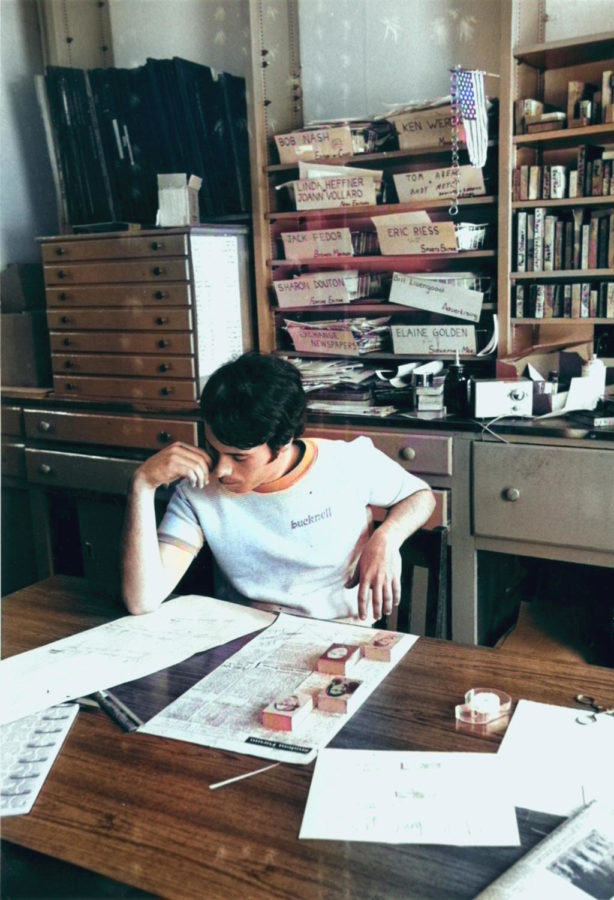
Bass first arrived at Bucknell in the fall of ’75, from New York. He’d started out as a music major, though he “didn’t want to go to a conservatory,” which ultimately ended up being “a really good decision” for him; however, Bass’s commitment to his clarinet was consistent, so “for two years, every couple of weeks,” he commuted “into New York to see [his] clarinet teacher,” often traveling with another Bucknellian whose viola teacher was also located in NY. He played in Bucknell’s orchestra—not the band, though he did tour with them “kind of last minute” over one spring break—and became “the student manager of the performing arts series,” which was “fun” and gave him the opportunity to “go to New York […] to the performing arts booking convention,” making the whole thing “worth it.”
As the student manager of the performing arts series, Bass encountered some aspects of hosting performers that he hadn’t anticipated. At one point, “the Moscow Chamber Orchestra came,” and because at the time Russia was still the Soviet Union, the performers “literally had KGB agents with them.” Bass couldn’t actually get anywhere near the Orchestra members; the KGB was too “worried about people defecting”!
But the experience stuck with Bass, and he ended up in a grad school program “in the business school and arts management” at the University of Wisconsin after graduating from Bucknell in 1979. Though he’s consistently worked in public media, ultimately spending twenty years as the President of Oregon Public Broadcasting, Bass bounced all over the country before settling in Portland. He started out interning in Wisconsin in 1980; eventually moved to Washington, D.C. for a role at PBS; hopped to Springfield, Massachusetts as a station manager, then a Senior Executive role in Boston; took a position in Nashville for seven years; and, finally, landed in Oregon.
“Public media kind of has had three eras,” Bass explained, “and we’re entering the third,” because, as the internet has grown pervasive and streaming models the industry giants, “broadcasting is not the only way you can get the content now.” When public media began in the 1920s, “land-grant universities like Penn State and Oregon State started putting radio stations on the air as a way of connecting rural and largely agrarian states,” experimenting with a format that ended up going on “for over 40 years” in that “very locally-focused, independent” manner “unique in every community.”
Then, with the advent of “wire recordings and audio tape,” followed by the ability to “put audio over phone lines” in the ’30s and ’40s, the “Public Broadcasting Act” was passed to “provide funding and create a structure.” Public broadcasting, for the first time, was becoming “a national enterprise,” much more like “a network,” as we might think of it today. “Radio and TV stations effectively had a local monopoly” on the distribution of programming, as Bass put it, so growth was “very distribution-focused.”
“That’s the part that’s breaking down” with modern broadcasting, in Bass’s experience. Nowadays, “you can get [that content] on podcasts.” PBS programming, for example, “is now showing up on Amazon Prime, because they have to sell off the rights in order to get enough money” to produce it in the first place. Some stations that “haven’t figured out what their local uniqueness is” are being left “in the lurch” as broadcasting shifts back towards a local value “pretty quickly.” The organizations with a “bulked up local newsroom,” filling “a very significant role in this kind of challenged local media ecosystem,” are, in Bass’s opinion, “going to figure out a way forward,” because they have “a local value proposition.” To Bass, public broadcasting is “heading towards an environment that’s much more like the first 40 years than the last 60”— and though it’s up to time to prove him right, he doesn’t think there will be much of a need “for a national broadcast television and radio network for much longer,” given that most things are “coming over satellite, […] Internet and broadband and social media.”
On his time at Bucknell, Bass reflects fondly. Thinking back, one of the most valuable elements for him was “the faculty relationships” he was able to cultivate here, an experience he knows “is not the case in other larger schools.” Those connections have “something pretty special” about them, and in Bass’s mind, “if you don’t take advantage of it, you’re kind of missing something.”
The “range” of his “experiences,” and the “relationships [he made] with people,” still impact Bass to this day. In fact, he’s in contact with friends from his university days, and has run into Bucknell alum from other class years throughout his time in professional spaces.
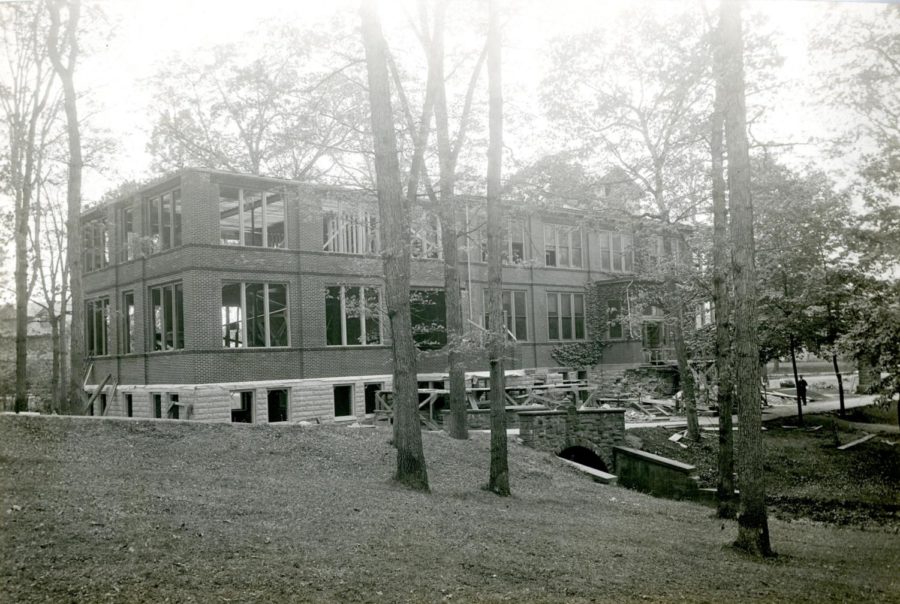
Coming back to campus highlighted, for Bass, “a lot of change.” Newer buildings like Academic East and West were fields, the last time he was wandering around Lewisburg; “they’ve added an immense amount of stuff,” Bass said cheerfully, especially admiring of the plethora of comparatively new on-campus athletic facilities.
If there was one thing he was definitely looking forward to, though, it was revisiting the local House of Pizza on Market Street— which “has not changed in 50 years.” He can still recite the phone number; and “besides the prices,” going back into the restaurant was “exactly the same” for him.
To students, Bass repeatedly wanted to emphasize how willing most alumni are to talk and help. “Anybody wants to reach me on LinkedIn, go for it!” Bass said. “I’m always happy to talk to students who reach out to me if I can be of help.”
Bass is “really appreciative of the folks at the [Perricelli-Gegnas Center for Entrepreneurship & Innovation]” for inviting him and giving him the opportunity, and moving forward, he hopes to “stay engaged” with the Bucknell community.

