











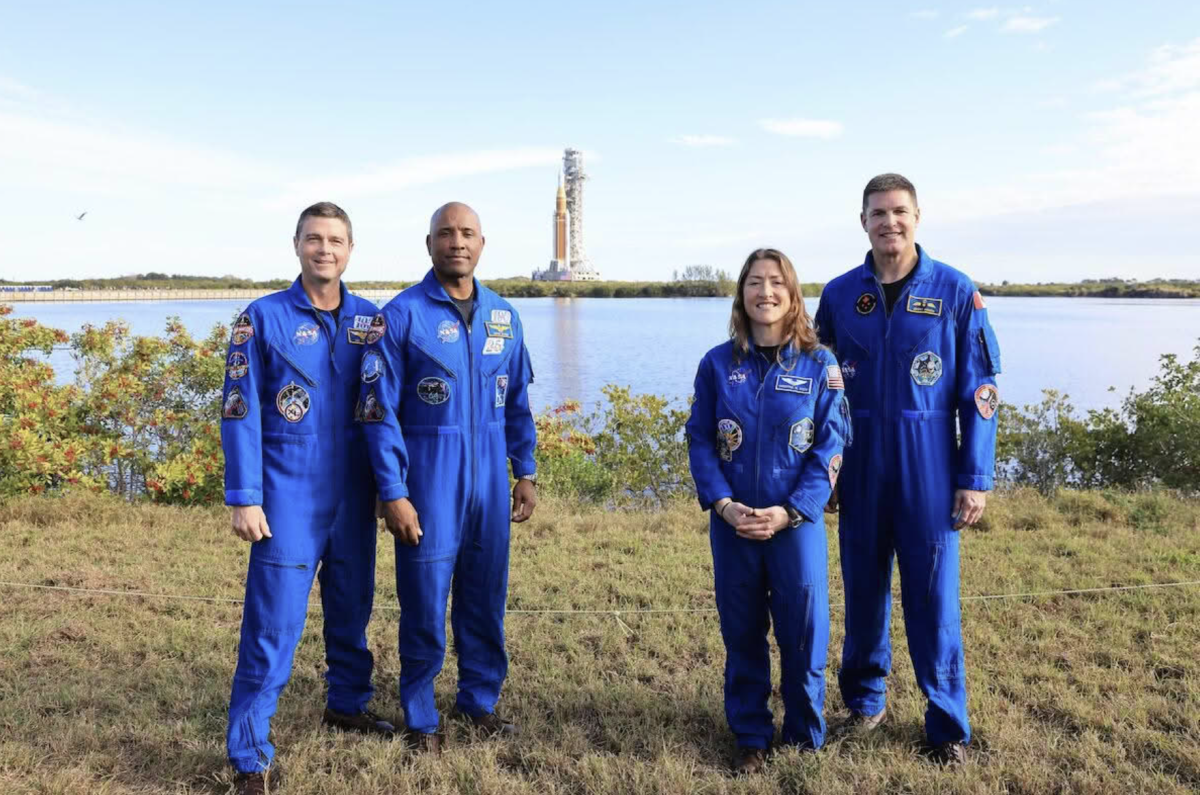
On April 6, President Donald Trump hopped on a phone call with the astronauts on Artemis II: Reid Wiseman, Victor Glover, Christina Koch and Jeremy Hansen. During the 12-minute call, something hilarious happened: there was nearly a minute of awkward silence.
Just before the silence, Trump told the astronauts, “Well, I have to say, I spoke to a very special person, Wayne Gretzky, who I think you know– the great one. And I spoke to your Prime Minister, and many other friends I have in Canada. They are so proud of you, and, uh, you have a lot of courage. I’m not sure if they’d wanna do that. I’m not even sure if the great one would wanna do that, to be honest with you. But you have a lot of courage doing what you’re doing, a lot of bravery, and a lot of genius, but they’re very, very proud of you.”
As Trump was making this statement, the astronauts could be seen laughing hysterically, seemingly at the way in which the microphone was floating around in front of them and then they simply gave Trump a thumbs-up before the minute of awkward silence commenced.
Later, Trump simply chalked it up to a delay in communication or being cut off. The internet had other ideas, attributing the awkward silence to the astronaut’s lack of desire to speak to Trump.
Regardless of why this awkward silence occurred, whether due to a lack of having anything to say to the president or simply to technical errors, the awkward silence was comically symbolic. Artemis II is a scientifically significant mission because it is the first time humans have entered the Moon’s vicinity in more than 50 years and it is the farthest from Earth any humans in history have traveled (252,756 miles). Given Trump’s history of rejecting science, whether climate change or vaccinations, it was ironic to see him so complimentary of these astronauts on the phone. The minute of silence between the two felt like a representation of the disconnect between the values of either party. Even if Trump was willing to be complimentary to their faces, it is clear that there was an unwillingness to accept his factitious appraisals.
When scientists interact with science-deniers, there is a palpable tension. This moment made us aware of that. But what feels most concerning at this point in time is the implicit necessity for the astronauts to censor themselves for the sake of their own livelihood, especially with Trump’s recent history of slashing funding for scientific research.
It is standard for a president to call individuals who are at the forefront of major American achievements, but the sociopolitical context that preceded this phone call specifically made clear that the level of American nationalistic pride that once existed during these phone interactions is rapidly fading. Scientists are not in a position where they can speak freely with the president, particularly because the president is actively working against them.
What does this mean for the tradition of the congratulatory phone call with the president? Is this custom rapidly dying? Will censorship when speaking to the president become the new custom?
This is all hard to answer concretely, but it is clear that, at minimum, this moment represented a shift in the dynamics of such a tradition. When people fear that their interests are being threatened, these interactions are bound to recur and I anticipate an increase in awkwardness during congratulatory phone calls. Either way, I kind of hope awkward floating microphones become standard practice during these kinds of interactions with Trump.